Hangzhou: West Lake, Tea Hills, And The Easiest Day Trip From Shanghai
Forty-five minutes from Shanghai by train and a completely different pace. The lake is the headline, but the tea hills behind it are where the city actually lives.
Hangzhou is what happens when a city gets rich enough to keep its lake. West Lake sits right in the middle of a metropolis of twelve million, ringed by willows, causeways and low hills with pagodas on them, and it has been written about by Chinese poets for roughly a thousand years. It is also, inconveniently, free and therefore busy.
Two days is right: one for the water, one for the tea hills behind it and a canal-side evening. If you’re based in Shanghai, one long day gets you the lakeside walk and a boat, and you’ll be back in time for dinner.
Arriving from Shanghai and beyond
Hangzhou East receives the high-speed services from Shanghai Hongqiao — 45 to 60 minutes, ¥73–93, and there are departures every fifteen minutes through the day, so you genuinely don’t need to book weeks ahead. Xiaoshan Airport (HGH) is about 30 km east, on Metro Lines 1 and 19, roughly 45 minutes and ¥8 to the centre.
| Route | Journey time | Second class |
|---|---|---|
| Shanghai Hongqiao → Hangzhou East | 45 – 60 min | ¥73 – 93 |
| Beijing South → Hangzhou East | 4h30 – 6h | ¥540 – 620 |
| Hangzhou East → Huangshan North | about 1h30 | ¥110 |
| Hangzhou East → Suzhou | 1h30 – 2h | ¥110 |
West Lake, at the right hour
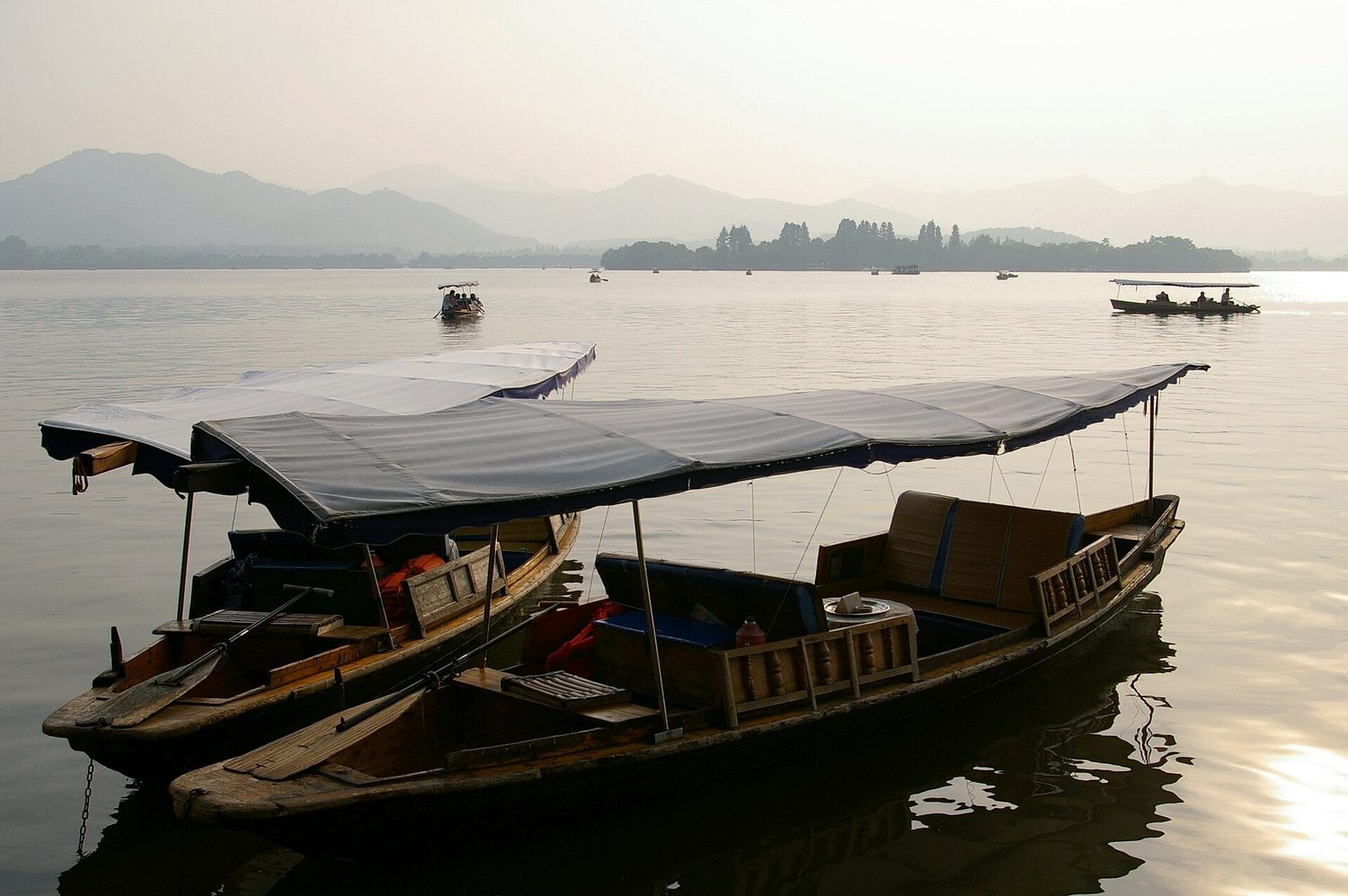
There is no entry fee. You walk it — the full circuit is about 15 km, or you take a boat across for ¥50–70, or you rent a bicycle and do the causeways. The Broken Bridge, the Three Pools Mirroring the Moon and the Leifeng Pagoda are the named stops, and the pagoda charges its own fee.
The thing nobody tells you: on a national holiday, the causeway becomes a slow-moving crowd and the whole place feels like a queue with scenery. Visit on a weekday, arrive before 08:00, and the same path is empty, misty, and worth all the poetry written about it.
Tea: Longjing village and how not to be sold to
Behind the lake, the hills around Longjing village grow the green tea that carries the village’s name. You can walk into the tea museum for free, wander the terraces, and sit in a farmer’s house with a pot of tea for ¥50–100. Pre-Qingming tea — picked before early April — is the expensive grade; prices for it are high and the fakes are numerous.
If someone offers you a “special price, for you only” at a shop near the lake, it isn’t special. Buy from a producer in the village where you can see the bushes, or from a supermarket shelf where the price is printed.
Temples, silk and a wetland
Lingyin Temple, in the hills west of the lake, is the big one: ¥45 for the Feilai Feng grottoes plus ¥30 for the temple itself, and it’s worth the combination. The Grand Canal’s old quarter at the northern end is free, has museums on it, and is far emptier than the lake.
Hangzhou served as the Southern Song capital for a century and a half, and the city trades on that inheritance in ways both dignified and commercial. The silk museum, on the southern edge of the water, is free and genuinely good — looms, brocades, a room of imperial robes — and it is almost always empty. Xixi Wetland, out west, charges about ¥80 and gives you an hour on a punt through reeds and fish ponds, which is a better use of an afternoon than another circuit of the shore.
What to eat, by name
Order dongpo pork, a block of belly braised until it collapses, around ¥60–90 in a mid-range restaurant. Longjing shrimp — river prawns stir-fried with fresh tea leaves — is lighter than it sounds and priced by the season, usually ¥80–120. Beggar’s chicken, clay-wrapped and baked, needs ordering in advance at most places and feeds four. Breakfast is the underrated meal here: steamed buns and a bowl of soy milk for under ¥15, eaten at a plastic table on the pavement.
Where to stay and what it costs
Lakeside rooms carry a large premium for a view you can get by walking outside, so consider staying a few streets back or near the canal and spending the difference on food. Mid-range doubles run ¥500–900. A bowl of pian’er chuan noodles — the local wheat noodle with pickled greens and bamboo shoots — is ¥15–25, and the city does an excellent version of it.
Season
Late March to May for blossom and the tea harvest, September to November for osmanthus and clear air. July and August in Hangzhou are brutal — the city sits in a bowl and regularly hits 38°C with the humidity of a wet towel. Winter is quiet and cold, and the lake looks good in snow, which happens about once a decade.
Mistakes people repeat here
- Only seeing the lake. The tea hills and the canal quarter are where you’ll have actual space.
- Arriving on a public holiday weekend and concluding that Hangzhou is a tourist trap.
- Paying a lake “entry fee” to anyone. The lake is free; boats, pagodas and temples are not.
- Buying expensive tea near the lake without seeing a single tea bush.
Questions people actually ask
Can I see Hangzhou in a day from Shanghai?
Comfortably, if you start early. A 45-minute train gets you there before 09:00; walk the lake, take a boat, eat noodles, and you can be back in Shanghai for dinner. Two days lets you add the tea hills, which is the better half of the city.
How crowded does West Lake actually get?
On a normal weekday it’s busy but walkable. On the first day of a national holiday it’s shoulder to shoulder on the causeways. The lake is 6.4 square kilometres, so the crowd disperses if you walk ten minutes away from the main bridge — most people don’t.
Is Hangzhou worth it if I’ve already got Suzhou on my list?
Yes, but they’re different. Suzhou is about walled gardens and canals — designed, enclosed, human-scale. Hangzhou is about a lake and hills — open, weather-dependent, better for walking. If you only have time for one and you like walking, pick Hangzhou; if you like gardens, pick Suzhou.
Rail frequencies, temple entry and boat fares checked against operator timetables in September 2026. West Lake has no entry fee and never has — anyone selling you a lake ticket is selling something else.